


Major Immigration Changes in 2026: What Families Should Know Now
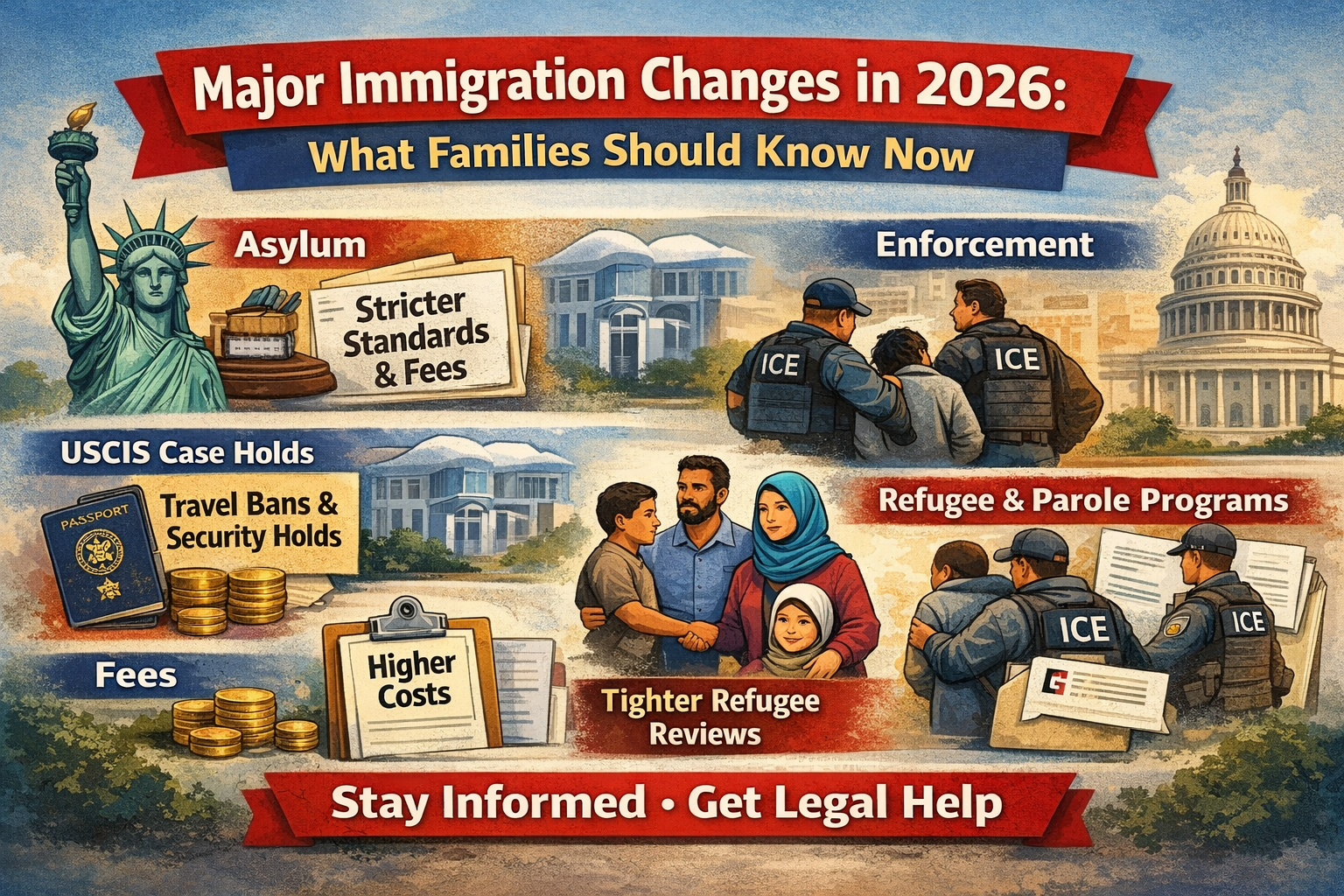
The start of 2026 has brought some of the biggest shifts in immigration law and policy that we’ve seen in years. New court decisions, agency policies, travel restrictions, fee increases, and enforcement trends are reshaping how cases are handled in asylum, family immigration, business visas, and removal defense.
Below is a clear, easy-to-follow overview of the most important changes. We grouped them by category so immigrants, families, and community members can understand how these developments may affect their cases.
I. Asylum Law: New Standards and New Fees
One of the most important changes comes from the Board of Immigration Appeals in Matter of E-M-F-S. This decision raises the bar for asylum seekers who rely on threats of violence to prove persecution. The Board ruled that death threats—especially anonymous ones—usually do not count as persecution unless the person making the threat is clearly identified and has the ability to carry it out. This means asylum cases must now include stronger evidence, such as the identity of the persecutor, past harm, police reports, and proof that the threat was serious and immediate.
Another major development involves asylum fees. USCIS has paused the Annual Asylum Fee (AAF) while a federal lawsuit continues, but the immigration courts (EOIR) are still applying their own separate fee rules. Judges now have the discretion to ask for a $100 asylum filing fee even in older cases, creating confusion and inconsistent decisions across different courts. Asylum seekers should keep every receipt and ask their attorneys whether their specific case is affected.
II. Removal Defense: Appeals, Notices, and Due Process
Several new decisions affect how people fight or reopen removal orders. Under 8 U.S.C. § 1252, all challenges to a final removal order must now go through a Petition for Review filed in a federal appeals court. District courts are no longer the place to challenge deportation orders except in very narrow situations involving custody or detention conditions. Acting quickly is essential, since appeal deadlines are extremely short.
The Board also issued a new decision in Matter of Laparra-Deleon, which makes it easier for judges to issue removal orders when someone misses court. Even if the first notice to appear had mistakes, a later hearing notice with the correct date and time is enough for the judge to order deportation. This reduces the impact of earlier Supreme Court cases involving defective NTAs and means all immigrants should treat every hearing notice—no matter how it arrives—as urgent and mandatory.
III. USCIS Case Processing: Travel Bans, Security Holds, and Refugee Reviews
USCIS has put thousands of cases on hold for people from 39 countries listed in a new Presidential Proclamation. Under Policy Memorandum PM-602-0194, USCIS may process parts of an application, such as fingerprints or interviews, but cannot make final decisions until new security reviews are complete. Even previously approved cases are being reevaluated.
Travel restrictions are expanding, too. A new proclamation blocks or limits visas and entry for nationals of the same 39 countries. In addition, the Department of State is preparing to freeze visa processing for about 75 countries. Anyone with immigration paperwork pending should avoid international travel until speaking with an attorney. Leaving the U.S. could result in being unable to return.
Refugee applicants are also experiencing new scrutiny. USCIS launched Operation PARRIS, a large-scale effort to re-verify refugee cases that were approved between 2021 and 2025. More than 5,600 refugees in Minnesota have already been affected, with their green card applications paused. This program will expand to other states. Refugee families should prepare for requests for old documents, new interviews, and possibly challenges to their original admission.
Temporary Protected Status (TPS) holders also face new challenges. DHS announced that TPS for Somalia will end on March 17, 2026. Somali nationals should contact an attorney immediately to explore other forms of relief before their protection expires.
IV. Fees and Processing Costs: Higher Prices for Faster Service
Beginning March 1, 2026, USCIS will raise the price of premium processing for many applications, including H-1B petitions, green card petitions, student visas, and work permits. Any request filed with the old fee after that date will be rejected. Families and employers who plan to file soon may want to submit their applications before March 1 to avoid the higher costs.
V. Enforcement Trends: Detention, Excessive Force, and Federal-State Conflict
Enforcement activity has intensified across the country. Congress is considering funding 44,500 immigration detention beds, signaling deeper enforcement efforts and longer detention periods. Advocates warn of worsening conditions, especially after a record number of deaths in ICE custody in 2025.
Minnesota has become the center of national attention after an ICE officer fatally shot Renee Nicole Good, a U.S. citizen and mother of three. Videos contradict official statements, and multiple lawsuits have been filed challenging excessive force by immigration agents. Courts may soon limit ICE’s use of force in certain states. More reports show that shootings and violent encounters involving immigration agents have increased sharply.
States are pushing back as well. Minnesota and Illinois have sued the federal government, arguing that Border Patrol agents are being deployed deep inside their states using “border-style” tactics that violate state sovereignty. These lawsuits may change how federal agents conduct arrests far from the border.
Our law firm has partnered with a civil rights litigation team to represent victims of excessive force. Anyone who has been physically harmed or threatened by immigration agents may have both an immigration defense argument and a possible civil lawsuit.
VI. Parole, Humanitarian Programs, and Legal Challenges
A major victory came recently when a federal judge blocked the termination of seven Family Reunification Parole programs, protecting thousands of families from losing their legal status. These programs remain active for now, but the decision is temporary and could change on appeal.
Another important case is CHIRLA v. Noem, where the court ruled that the government cannot place parolees—such as individuals admitted under CHNV, U4U, or CBP One—into expedited removal. This protects many families from sudden deportation without a hearing. However, violations have already been reported, and courts are watching closely.
Travelers who posted visa bonds must also be careful. The Department of State expanded the list of designated airports where visa-bond travelers can enter or exit the U.S. Using a non-designated airport may lead to bond forfeiture and future visa problems.
VII. Habeas Corpus and Supervision: A Case to Watch
The Fifth Circuit is hearing a major case, A.R.P. v. Trump, that will determine whether immigrants on Orders of Supervision, ankle monitors, or strict reporting requirements count as “in custody” for habeas corpus filings. If the court rules in favor of a broader definition of custody, many individuals living in the community—but heavily monitored—may gain new rights to challenge their situation in federal court.
VIII. Professional Responsibility: The Importance of Limited-Scope Representation Rules
With contractors, coverage attorneys, and high case volume, many immigrants work with multiple lawyers throughout their case. A reminder from the immigration courts emphasizes that if an attorney files an EOIR-28 (the form that enters an appearance), the law firm remains counsel of record until a judge formally approves withdrawal.
This matters because mismanaged appearances can leave clients confused and unrepresented. Good law firms must document limited-scope agreements clearly, supervise contractors, check for conflicts of interest, and file timely withdrawals. As immigration policies shift rapidly, responsible representation is more important than ever.
IX. Subscription-Based Legal Services: A New Option for High-Risk Clients
More immigrants live with constant fear of detention or deportation. To help families prepare and access legal support when emergencies arise, our law firm now offers a subscription-based service model. For a predictable monthly fee, clients receive ongoing guidance, emergency planning, and legal coverage if they are taken into custody. This approach gives families peace of mind and ensures they always have an attorney ready to act when timing matters most.
Conclusion: Staying Informed and Protected in a Rapidly Changing System
So far, 2026 shows that immigration law is shifting at every level—courts, USCIS, the State Department, and enforcement agencies. Families should stay informed, avoid travel without legal advice, organize their documents, and speak with qualified attorneys before making decisions that could affect their status or safety.
Our firm continues to monitor these developments daily. Whether you are preparing an asylum case, waiting for a visa, facing court, or worried about enforcement, you are not alone. We are here to protect you, guide you, and help you navigate these complex changes with confidence.